
Is Supplemental Private Soccer Training Worth It?
Is Supplemental Private Soccer Training Worth It?
By a private skills coach working with U11–U18 competitive players · Updated 2026
TL;DR: Private training isn’t automatically an advantage. It helps when the player wants it, the training targets real game weaknesses, and progress is tracked. Otherwise, it’s just expensive highlight-reel practice that may lead to burnout.
Parents ask me this question constantly — usually right after dropping $XXX on a trainer they found on Instagram. My honest answer: it depends. And most of the time, nobody is asking the right questions before they spend the money.
I've been training competitive youth soccer players for 10+ years. I've watched supplemental private training transform kids who were ready for it and I've watched it quietly damage players who weren't. This post is my attempt to give you the clearest, most direct answer I can.
First, let's talk about what most people get wrong
Walk into any skills session at a local facility/field on a Tuesday night and you'll see it immediately: a trainer running a player through behind-the-back flick-ups, rainbow kicks, and elastico combos. The kid looks great. The parent is filming it. And almost none of it will ever show up in a real game.
The #1 mistake I see is parents and players chasing flash skills instead of game skills. The best private training is invisible and you only notice it when the player makes better decisions under pressure"
This isn't a knock on technical traines out there. But the industry has a marketing problem: dramatic skills get clicks, shares, and new clients. Game intelligence doesn't film well. So the incentive is to train for the highlight reel, not for the starting lineup.
Who should actually pursue private training
Supplemental training is not for every player at every moment. After working with hundreds of athletes across the U11–U18 competitive range, here's my honest framework:
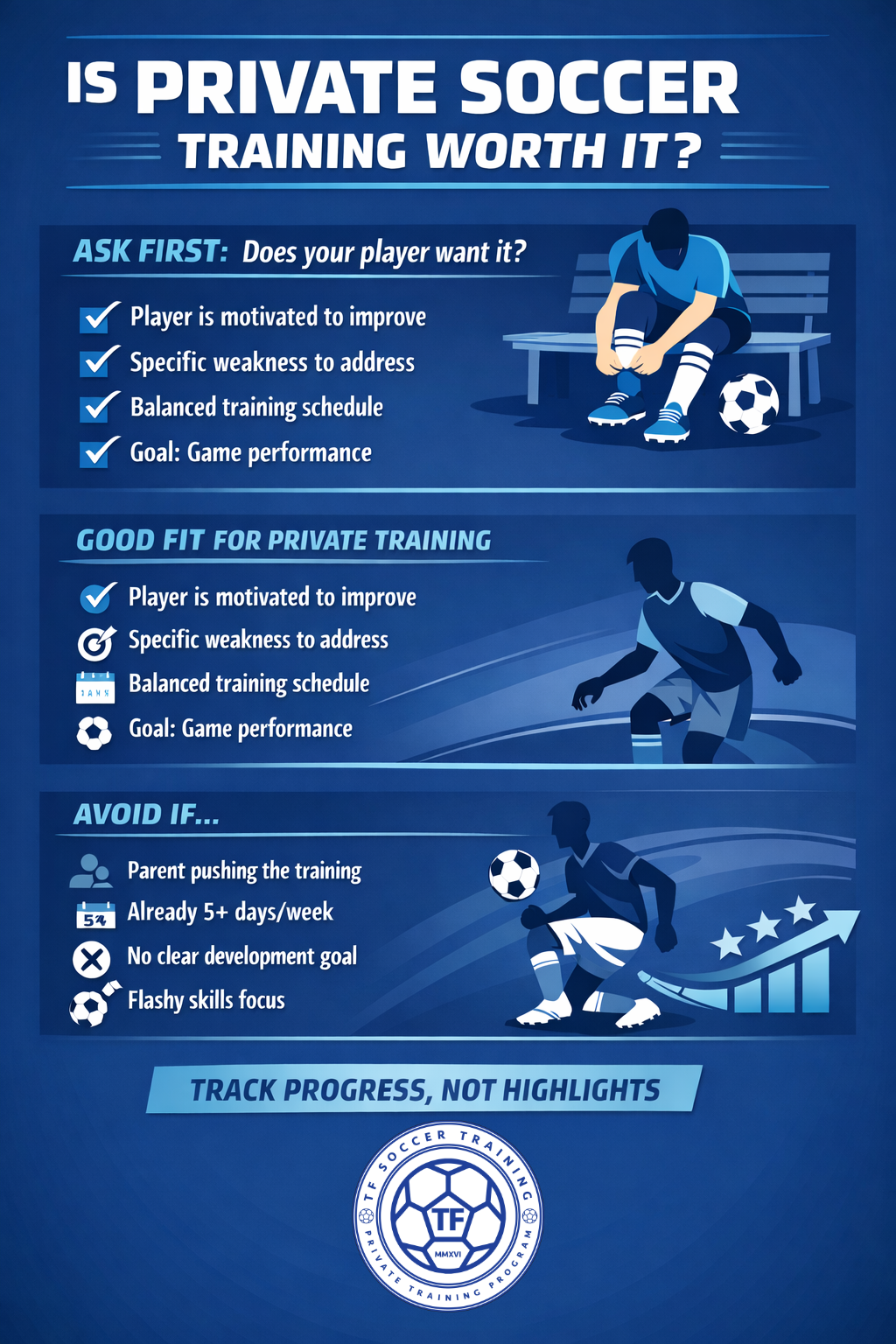
Good fit
Player is self-motivated — they asked for training
Has a specific, identified weakness to address
Training 3–4 days/week with room in the schedule
Player is willing to be uncomfortable and corrected
Goal is game improvement, not highlights
Not a good fit
Parent wants it more than the player does
Already training 5+ days/week (burnout risk)
No clear development goal — just "get better"
Player under U7
Wrong trainer: no progress tracking, no plan
The player motivation point is the one I feel most strongly about. I've declined to continue working with players because I could tell the sessions were the parent's idea, not theirs. You cannot buy a child's intrinsic drive. And without it, private training just adds pressure to a kid who already has plenty of it.
Two real stories from my training log
Success story
A U15 center back came to me after getting passed by on the wing repeatedly in games. His club coach had noted his first touch was inconsistent under pressure. We spent 6 weeks exclusively on receiving mechanics and body positioning before the ball arrived — no tricks, nothing flashy. By the end of the season he was starting and had earned a tryout at a higher-level club. His club coach noticed before his parents did. That's how you know it worked.
Cautionary tale
A U13 forward came to me for 3 months at his dad's insistence. The player was already training 6 days a week. Every session, he showed up tired. He went through the motions, learned a few moves, and by the end — quit the sport entirely at 14. I don't blame the training. I blame the lack of anyone asking the player what he actually wanted. Private training was the last straw on an already overloaded schedule.
What real ROI looks like
If private training is working, here's what you should see — roughly in this order:
Confidence in games, not just training. Skills that only appear in low-pressure drills don't count. If you don't see it on game day within 6–8 weeks, something isn't working.
More playing time. The club coach notices. That's the real report card — not what the trainer tells you after the session.
Moves up to a higher-level team or earns a roster spot. Concrete, verifiable outcome — not vibes.
Develops a love for self-improvement. The best long-term outcome: a player who starts working on their own, who asks questions, who watches film. Private training should build intrinsic motivation — not dependency on a trainer.
How to evaluate a trainer before you pay
The biggest green flag I can tell you about? A trainer who tracks measurable progress. Not vibes. Not Instagram clips. Actual metrics: first-touch success rate under pressure, 1v1 win percentage in game situations, sprint times, or coach feedback reports. If a trainer can't tell you how they measure improvement — walk away.
A few red flags worth naming explicitly:
Sessions look like highlight reel content, not game-realistic scenarios.
No communication with your club coach. A good trainer should want that feedback loop.
No clear plan after the first session. "We'll work on what the player needs" is not a plan.
The player dreads going. That's information. Listen to it.
So — is it worth it?
For the right player, with the right trainer, at the right moment in their development: yes, absolutely. Private training can accelerate growth in ways that group sessions simply can't. The individual attention, the tailored focus, the measurable feedback — it's a real advantage when deployed correctly.
But for a burned-out kid whose parent saw a viral skills video? It might be the thing that ends their soccer career early.
Ask your player first. Then find a trainer who tracks progress, communicates with the club, and trains for the game — not the camera. The rest tends to take care of itself.