
How to Create a Self-Training Routine That Actually Works
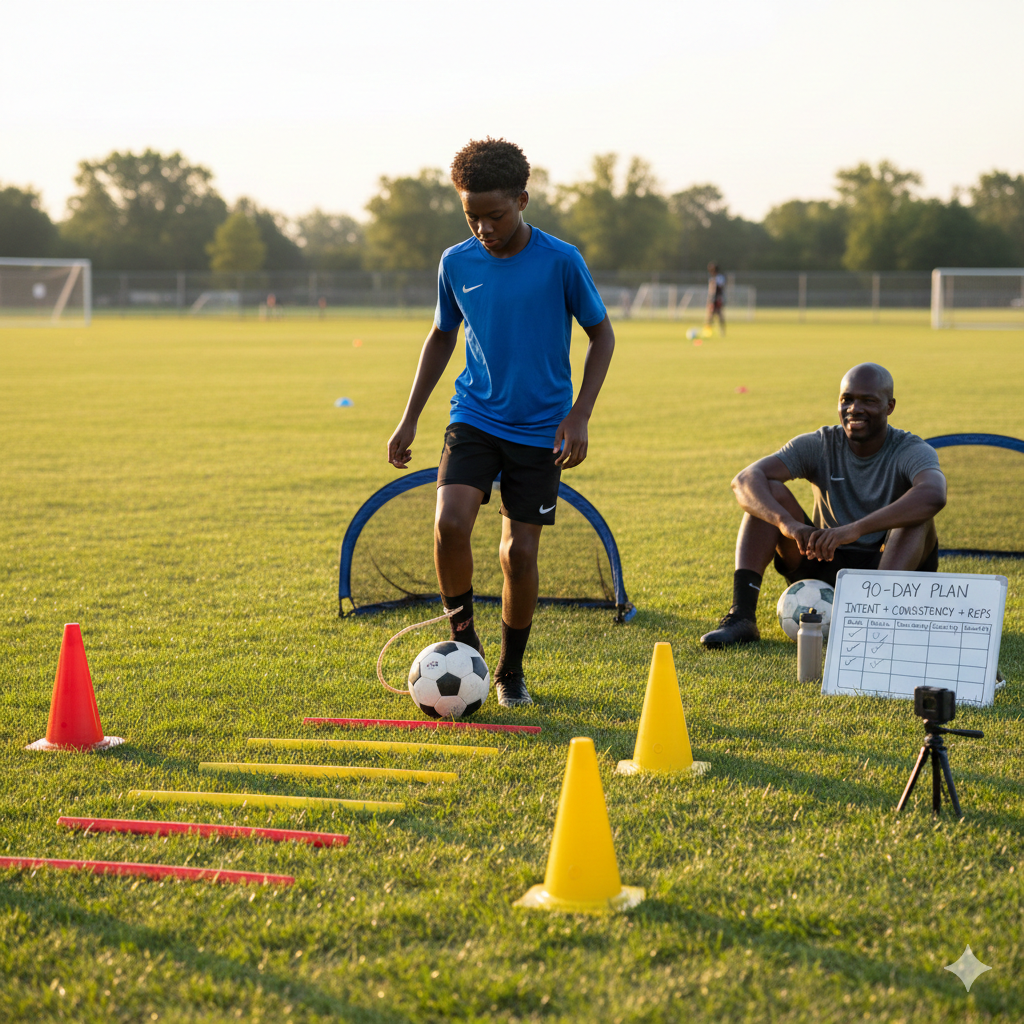
I first realized players could train a lot and still not get better when parents started telling me stories like Julia’s. Her parents said, “She goes out to the field with a couple of teammates all the time, shoots, dribbles, practices for 2–3 hours.” On paper, that sounds like dedication, right? But the reality? She wasn’t improving the way she could. That was the first time it clicked for me: time spent isn’t the same as growth—especially if there’s no plan, no goal, no intentionality.
I’ve been that player too. I’d go out for hours, kick the ball around, and feel productive—but ask me if I was actually getting better, and the answer was often no.
Then there’s Ethan. Ethan trained hard. He would watch YouTube videos, dribble through cones, and practice constantly. But he lacked guidance. He didn’t have a routine that really pushed him or gave him measurable growth.
Once we structured his self-training—using clips from our in person sessions, timing exercises, racing against himself, alternating feet, stacking reps—everything changed. He hated some of it at first, but he saw the improvement. He went from barely being noticed on his team to one of the best players, a captain, an all-district player, and eventually someone with college opportunities. The secret? Intentionality and structure, not just time on the field.
The Most Common Mistakes in Self-Training
The biggest mistake I see teens make when training on their own is lack of intent. They go out, kick the ball around, dribble through the same patterns, maybe juggle, and think that counts as improvement. They’re not focusing on the things that actually matter: one-vs-one skills, accelerating into space, attacking with the ball, or improving their first touch under pressure.
I’ve also seen players with very little formal experience outperform those with club training, simply because they train smart, consistently, and with focus. Players like Joel—he didn’t have all the game experience, but he put in the work daily. The payoff? Tremendous growth.
Bad routines? There are two types:
All physical, no skill – players exhaust themselves with conditioning, sprints, agility, plyometrics, but are too tired to touch the ball effectively.
All easy skill work, no challenge – juggling, basic dribbling, or passing without focus. It feels fun but doesn’t push their limits.
The Routine That Actually Works
The simplest, most effective routine I’ve seen—and the one that creates the biggest long-term impact—is built around three daily segments:
Ball mastery and creativity – tight control, dribbling in small spaces, making decisions quickly.
First touch and juggling – improving how you receive, control, and manipulate the ball.
Passing quality – focus on weight, timing, and accuracy.
Start with just 10 minutes a day, then stack days. The key is intent + consistency + reps. If you can do that, you’ll be shocked at how fast a teen player can improve.
How Parents Can Help Without Hurting
Parents sometimes over-help. Sitting on the sideline, taking over the session, or “supervising” too closely can backfire. Teens need to feel ownership. That doesn’t mean no fun—it means join in, play, enjoy the game together, but let them own the practice. Even playing casually with a teen on the field can reinforce their love for the game and support their growth indirectly.
How to Measure Effective Self-Training
After a session, ask your teen: “Did you work on one thing, and did you feel better at it?” Effective self-training isn’t about exhaustion or constant frustration. It’s about focused improvement and that sense of accomplishment when they see themselves get better.
Your 90-Day Rule
If your teen can follow one rule for the next 90 days, it’s this: Make a plan—but don’t be afraid to adjust it. If a day is missed, pick it back up. Stack the sessions. Stay intentional. The growth will come.