
The 4 Stages of Player Independence
The 4 Stages of Player Independence
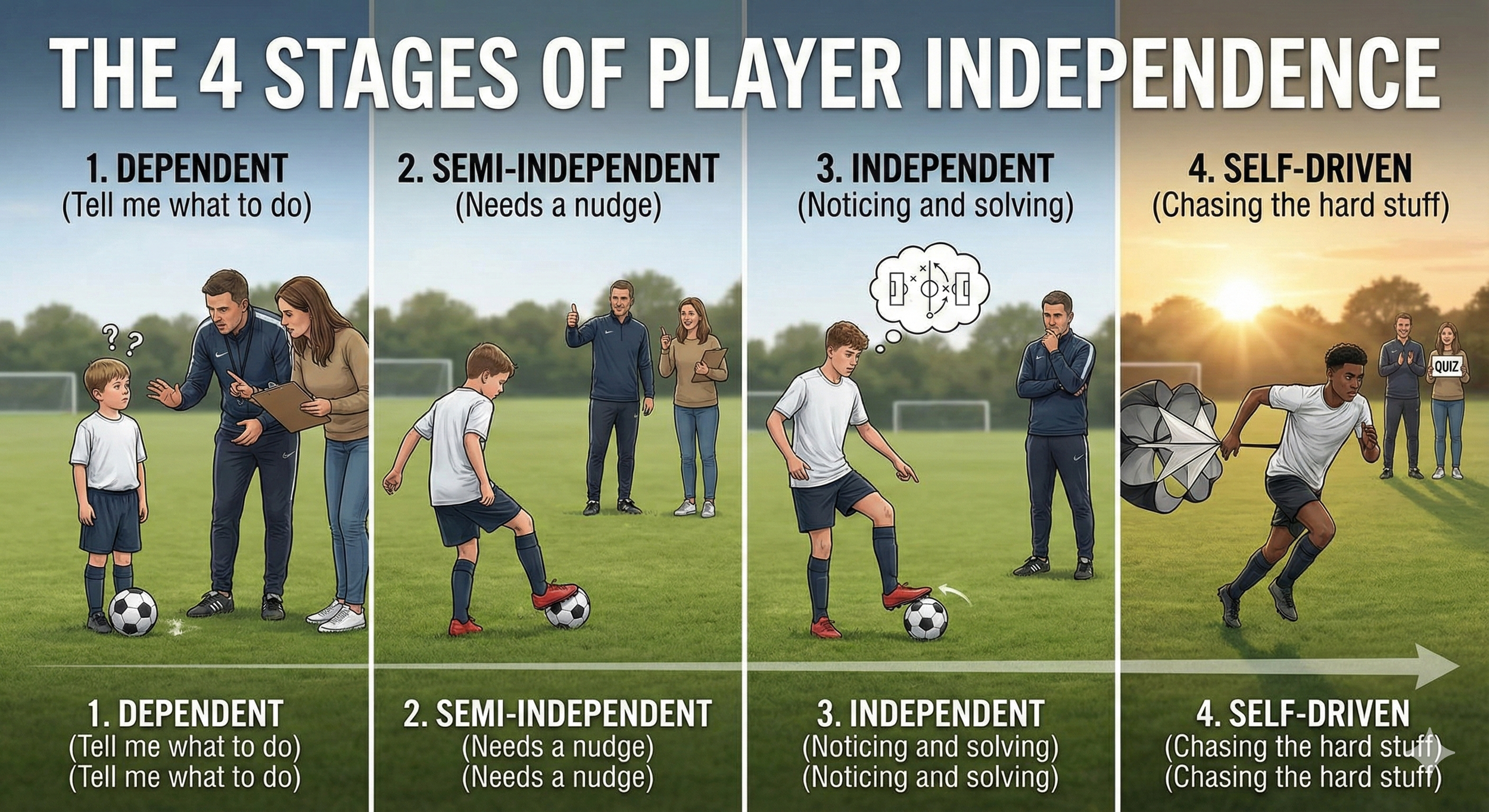
(and How to Guide Yours Without Doing the Work for Them)
If you've ever watched your kid freeze in a game and thought,
"Why aren’t they doing what we practiced?"
you’re not alone.
I talk to parents all the time who feel stuck between wanting to help their player and not wanting to hover.
It’s a weird place to sit in — because you want to step in, but you also know they need to figure some things out on their own.
And honestly?
That balance… it's hard.
I’ve lived this with so many players — but especially with one kid named Ethan. He’s kind of the heartbeat of this whole thing for me.
But let’s back up for a second.
What Independence Actually Means (On and Off the Field)
Most people think independence means:
“My kid trains on their own now. Boom. Independent.”
Not quite.
Independence is really about thinking.
Being able to see the problem… understand it… adjust… and solve it… without waiting for someone else to step in.
On the field, that looks like:
Better decisions
Faster reads
Not needing a coach to yell instructions every five seconds
Off the field?
Same deal.
Thinking ahead.
Planning their work.
Asking better questions.
Taking responsibility for their habits.
Here’s the piece that catches most parents off guard:
A trainer can teach skills.
A trainer cannot create independence.
Players create independence when they decide to.
And most kids struggle with that between ages 10–12 (and then again in high school, for different reasons). Those in-between years are tricky… because kids want freedom, but not always the responsibility that comes with it.
Enter: The 4 Stages of Player Independence
I’ve watched hundreds of players move through these stages.
Some move fast, some slow, some get stuck for a season or two.
And some — like Ethan — hit a switch and take off.
1. Dependent
This is the “tell me what to do” stage.
Totally normal.
Totally okay.
Kids here wait for direction.
They rely on reminders.
They’re not thinking the game — they're following steps.
This is where most middle schoolers start, even the talented ones.
2. Semi-Independent
Now this one’s sneaky.
Kids at this stage look independent, but only because someone’s always nudging them.
They’ll do extra training…
but only if you ask.
They’ll finish their homework…
but only if someone checks in.
They’ll improve…
but only with a push.
A lot of parents fall into the “rah rah, let me give you a schedule” trap here.
Not because they’re doing anything wrong — but because they want their kid to succeed so badly.
The problem?
If you’re the one driving…
they’re not learning to drive.
3. Independent
This is where things get fun.
This is where Ethan eventually landed.
He stopped waiting for me to tell him what wasn’t working.
He started noticing it himself.
He’d say things like,
“Coach, I think my first touch drifts too close under pressure,”
or,
“I’m losing time when I check my shoulder too late.”
I didn’t teach him that mindset.
I just created the space for him to use it.
And the growth?
It was obvious.
His touch sharpened.
His decisions got cleaner.
His confidence exploded — not because I said so, but because he earned it.
4. Self-Driven
This is the top level.
This kid trains because they want to.
They chase the hard stuff.
They reflect on games without being asked.
They see training as a resource, not a rescue team.
You can’t force a kid into this stage.
You can only support them until they find their way here.
And once they do… everything changes.
The Mistake Almost Every Parent Makes
(And I say this with total empathy)
Most parents think independence comes from structure.
“If I give them a plan…”
“If I remind them…”
“If I push them…”
But independence doesn’t grow in the presence of pressure.
It grows in the presence of ownership.
And that only happens when a player feels like their development belongs to them — not you, not me, not anyone else.
Your role?
Encourage.
Ask questions.
Be available.
Let them struggle a little.
Let them think.
Because you can’t build the fire for them —
you can only make sure it has oxygen.
So… which stage is your player actually in?
Most parents guess this wrong.
Your kid might be confident but dependent.
Hard-working but semi-independent.
Talented but not self-driven… yet.
If you want clarity — and a clear path to help them grow:
Take the quiz to find out what’s actually holding your player back.
It’s quick, simple, and ridiculously helpful.